Data Representation
Binary, denary and hexadecimal, two's complement, and how text, images and sound are stored.
FutureLogic provides a complete learning platform for Cambridge IGCSE Computer Science 0478 and 0984, combining interactive topic trainers, structured revision notes, and 535+ exam-style questions with instant marking.
Built directly around the 2026–2028 Cambridge syllabus requirements, our platform transforms passive textbook reading into guided interaction. Test your skills with our instant mock exams or explore our free starter resources below.
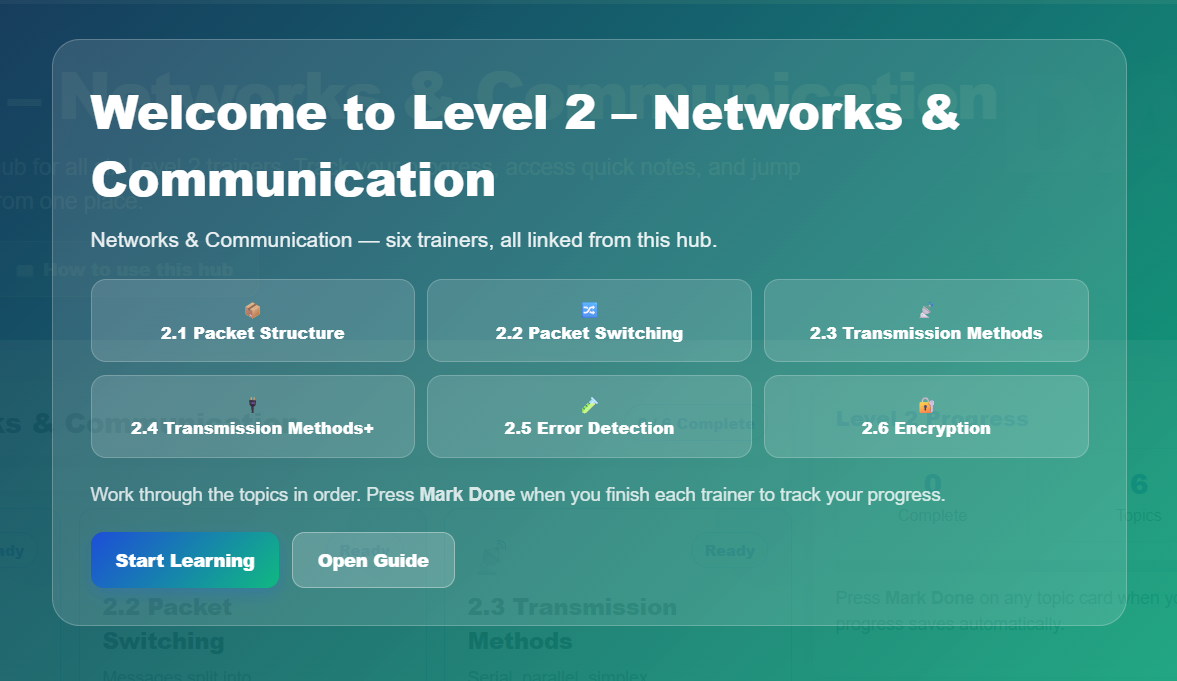
A 60-second interactive demo shows the FutureLogic method instantly: click, build, check, improve and move toward exam confidence.
Click the packet parts in the correct order: source, destination, packet number, checksum.
Which CPU factor allows instructions to execute simultaneously?
FutureLogic turns passive revision into guided interaction.

I've taught Computing for 25 years: 16 in the UK, then 10 in international schools in Thailand. I've taught Cambridge IGCSE Computer Science since 2016, alongside IB and A Level Computer Science, and I also teach Design Technology, electronics and robotics.
I started FutureLogic because good IGCSE Computer Science resources were hard to find, for teachers and students alike. So I built them: clear revision notes, interactive trainers and exam practice built around what Cambridge examiners reward, and tested with my own classes.
Revision notes and interactive trainers for every topic in the Cambridge IGCSE Computer Science 2026–2028 syllabus. Pick a topic to read the notes, then practise it in the Learning Hub.
Topics 1–6 · 1 hr 45 min · 75 marks · 50%
Binary, denary and hexadecimal, two's complement, and how text, images and sound are stored.
Packets, packet switching, transmission methods, USB, error detection and encryption.
The CPU and the fetch–decode–execute cycle, CPU performance, storage, and network hardware.
System and application software, the operating system, interrupts, translators and IDEs.
The internet and the web, browsers, digital currency, and cyber security threats and defences.
Sensors and automated systems, robotics, and artificial intelligence.
Topics 7–10 · 1 hr 45 min · 75 marks · 50%
The program development life cycle, flowcharts, pseudocode, trace tables, searching and sorting.
Data types, selection, iteration, totalling and counting, subroutines, arrays and file handling.
Single-table databases, primary keys and SQL queries with SELECT, WHERE, ORDER BY, SUM and COUNT.
Logic gates, truth tables, logic expressions and logic circuits from problem statements.
Practise the unseen scenario question at the end of Paper 2: read the task, identify inputs, processes and outputs, then write the solution in pseudocode, Python, Visual Basic or Java.
The free starter kit includes the complete Topic 2 Data Transmission pack and two interactive trainers, so you can see exactly how FutureLogic works before you buy anything.
Free • No payment neededFutureLogic gives students a clear route from first understanding to confident exam practice.
Your next step: Choose a topic and start learning.
Students are guided through the same consistent journey in every trainer: learn the idea, use the knowledge, practise independently, prepare for exam questions, review key traps and prove mastery.
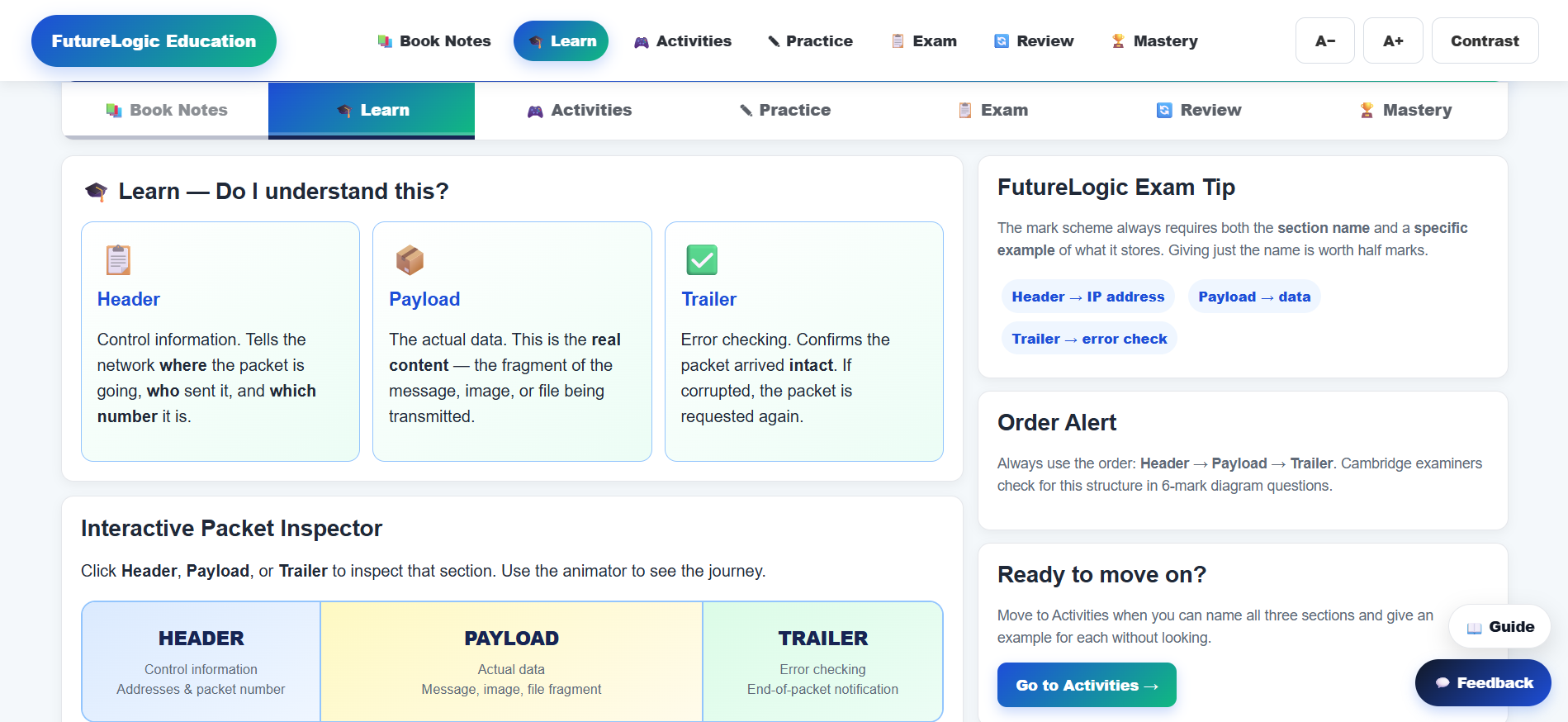
Visual explanations break difficult concepts into clear parts, with examples students can understand without teacher support.
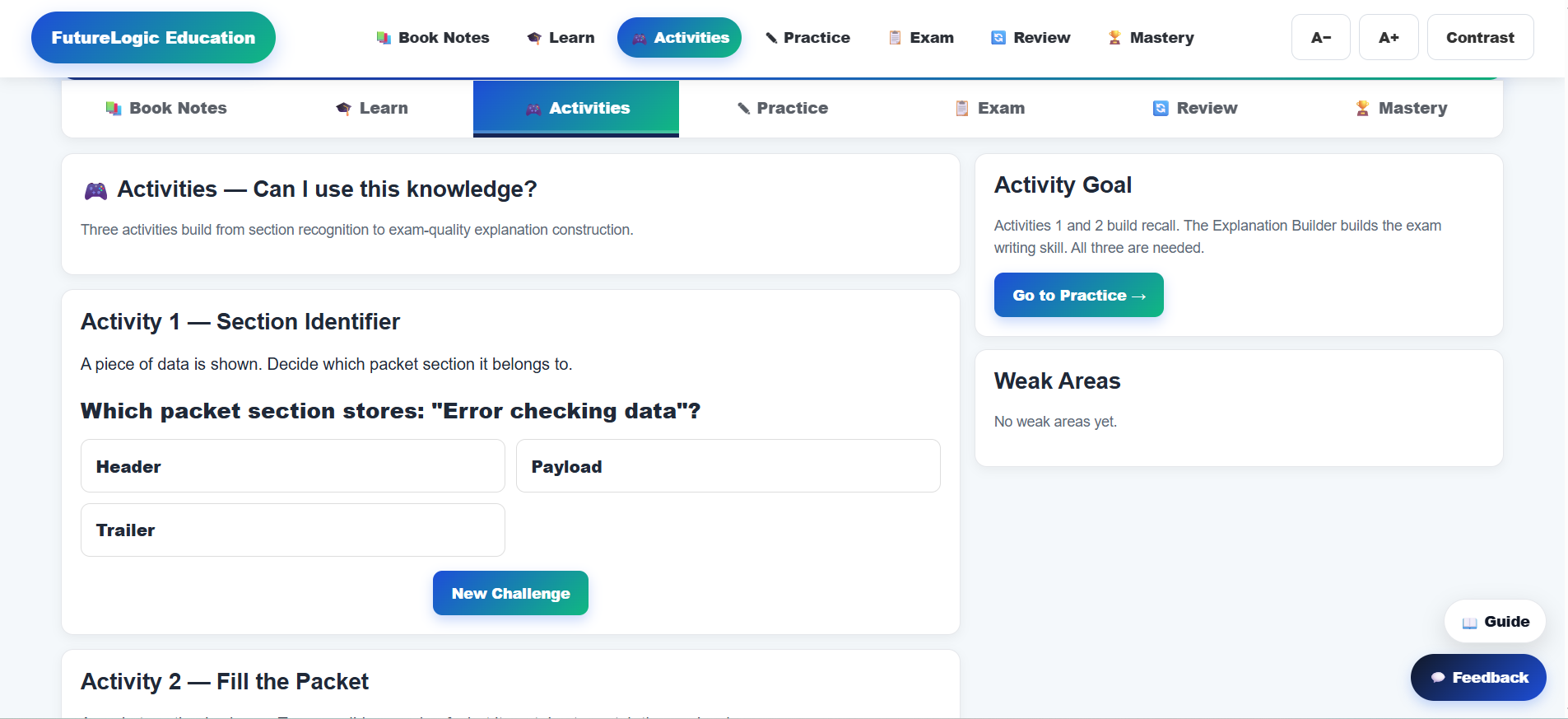
Interactive tasks turn passive reading into active recall, building confidence before exam-style questions appear.
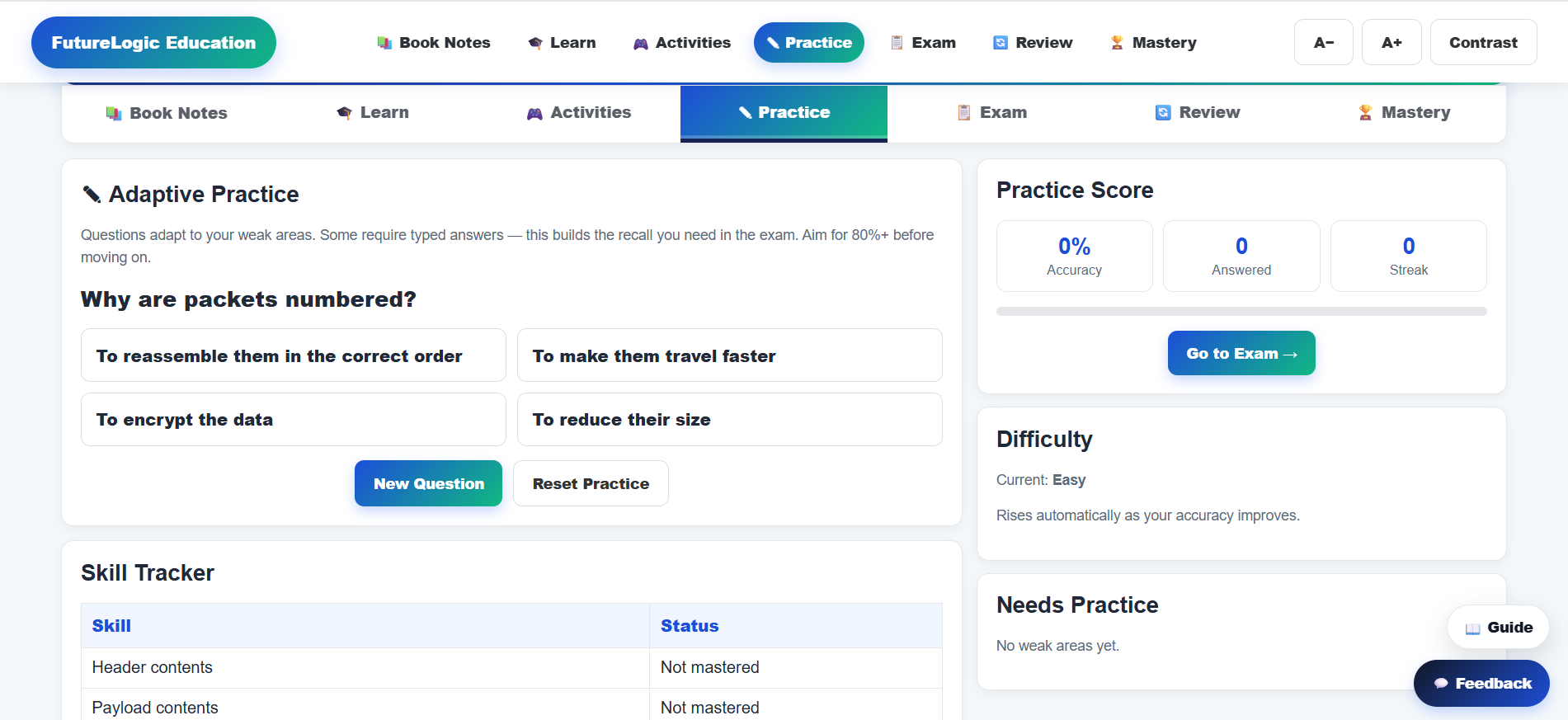
Adaptive practice helps students target weak areas, improve accuracy and build the recall needed for real exams.
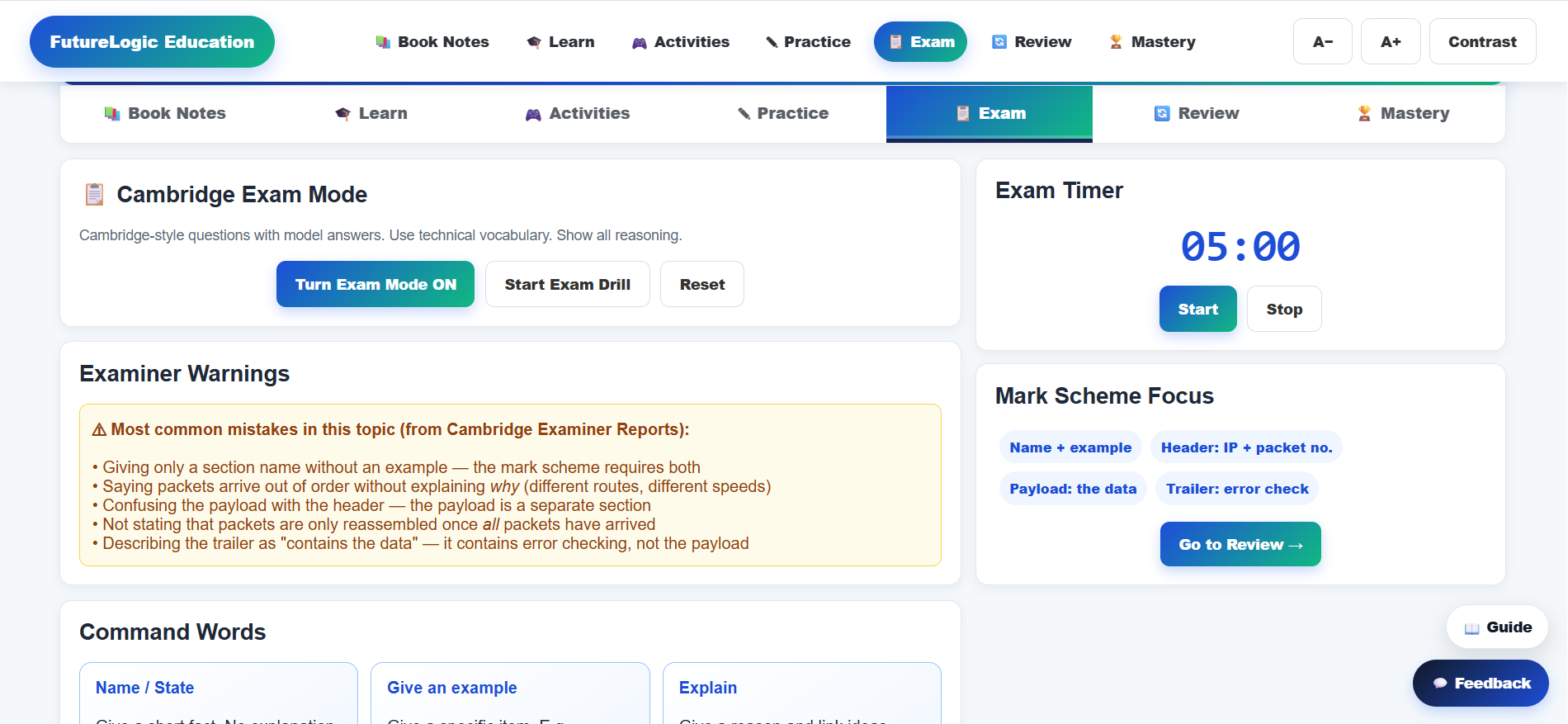
Cambridge-style practice, timed drills and examiner warnings train students to answer with mark-winning vocabulary.
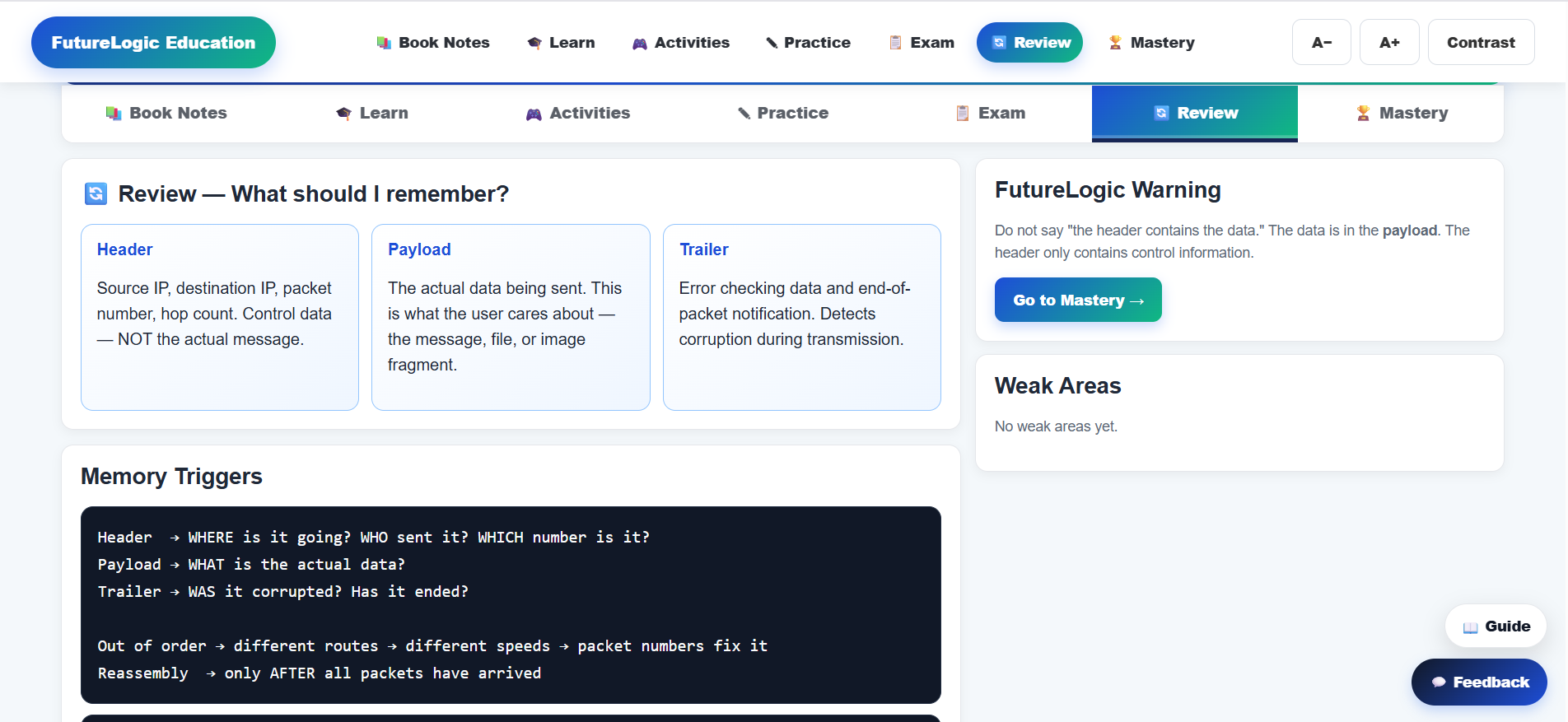
Memory triggers and common traps help students lock in the most important points before moving to mastery.
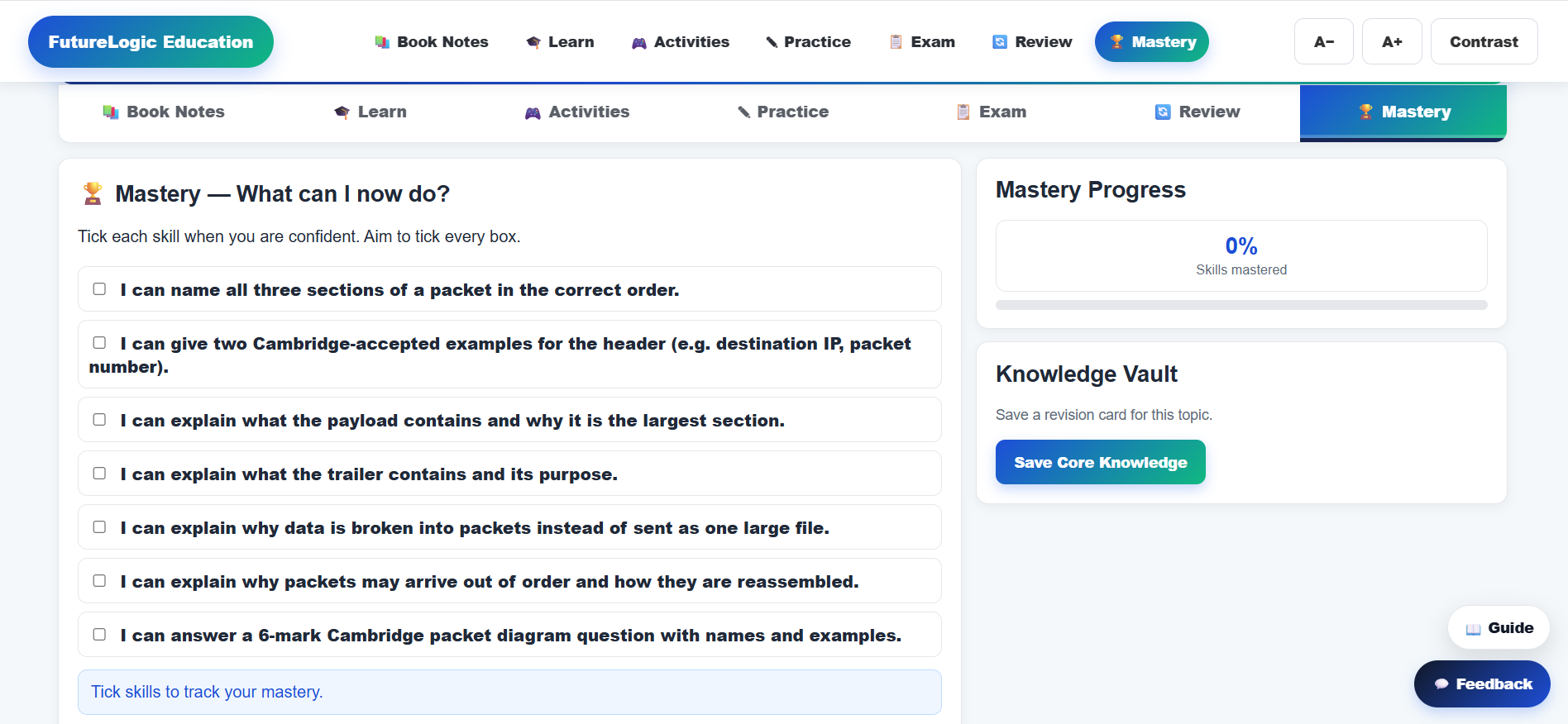
Checklists and progress indicators show students exactly what they can now do and what still needs practice.
FutureLogic organises Computer Science into clear pathways, topic hubs, trainers and exam challenges.
These previews show how FutureLogic moves beyond videos and PDFs into interactive, guided, exam-focused learning.
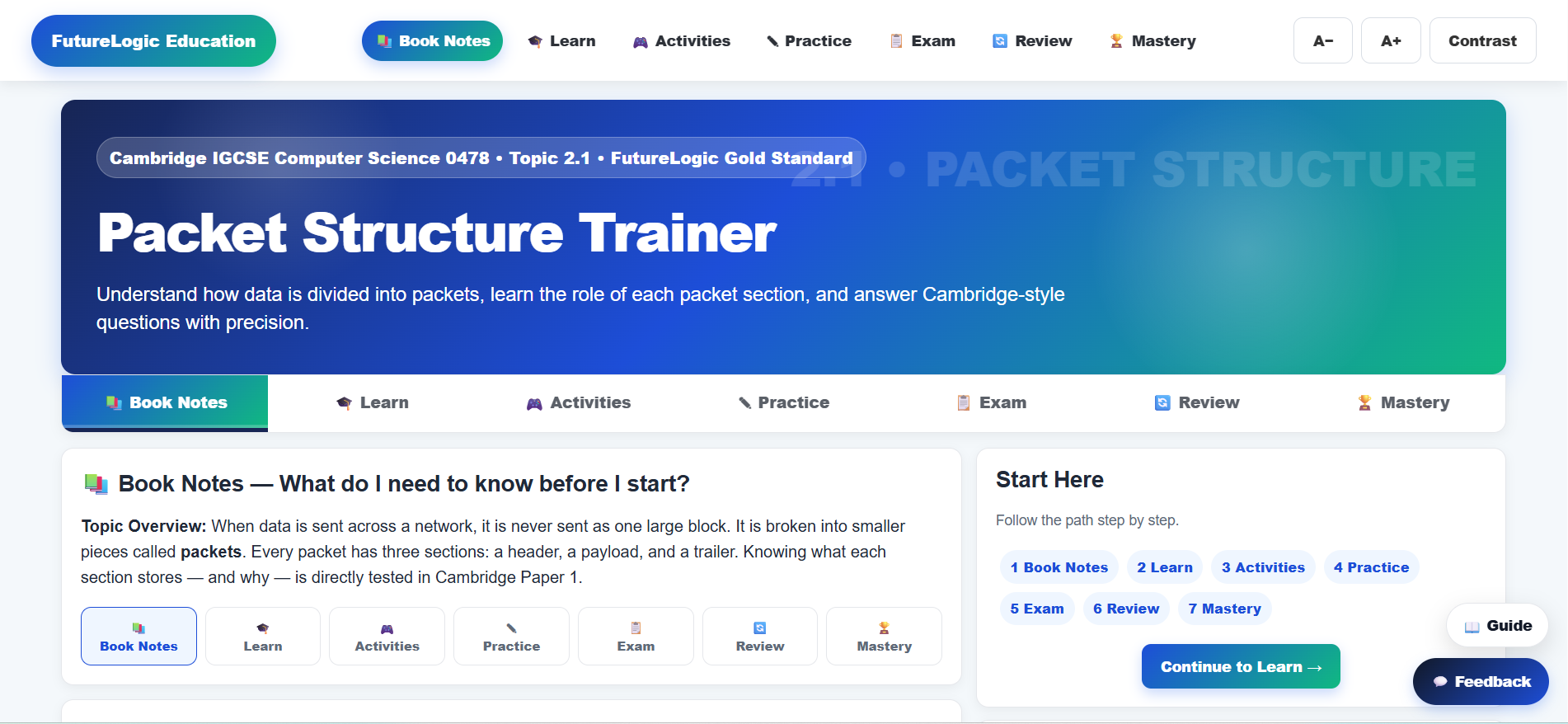
Students learn how packets are divided into headers, payloads and trailers, then practise using Cambridge-style vocabulary and examples.
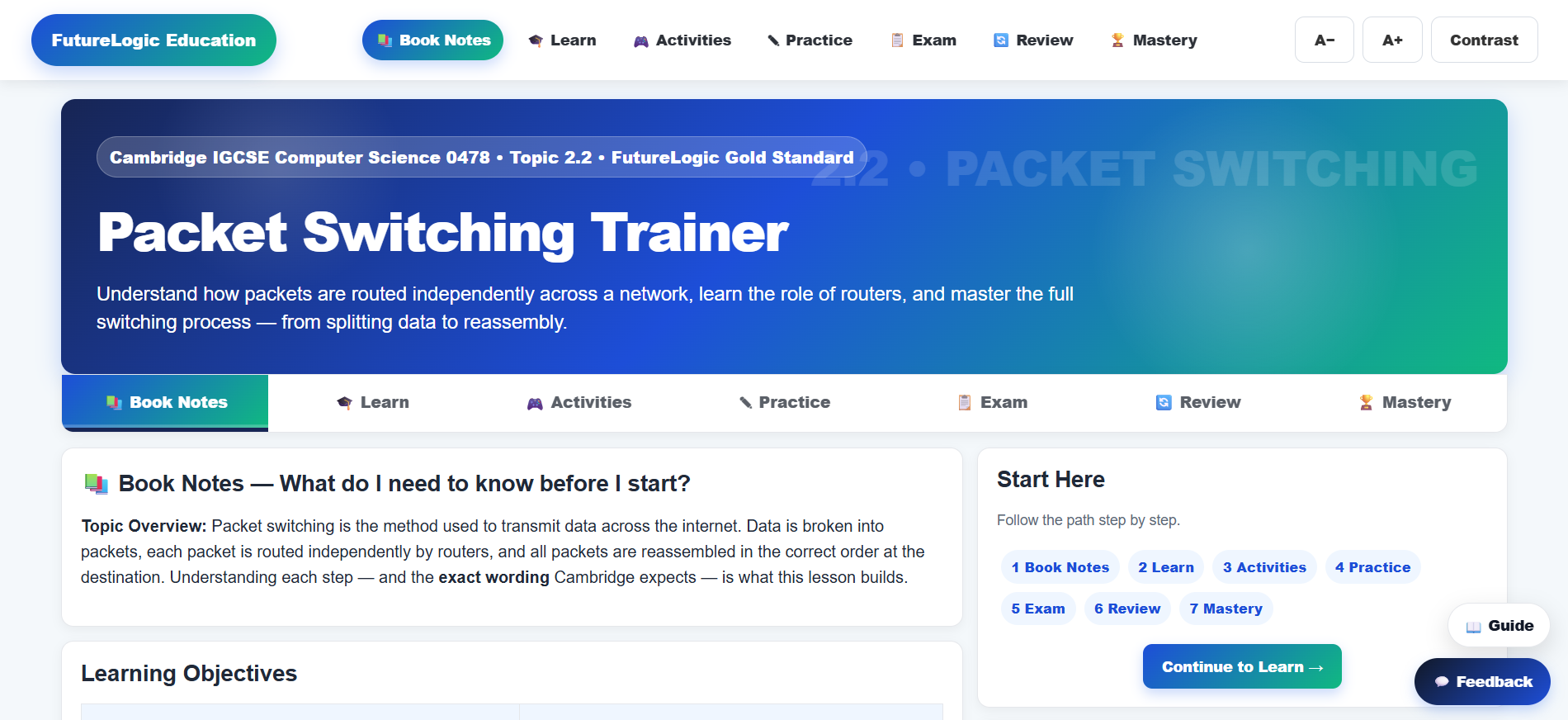
Visualise how packets travel independently, take different routes and are reassembled at the destination.
Open in the Learning Hub →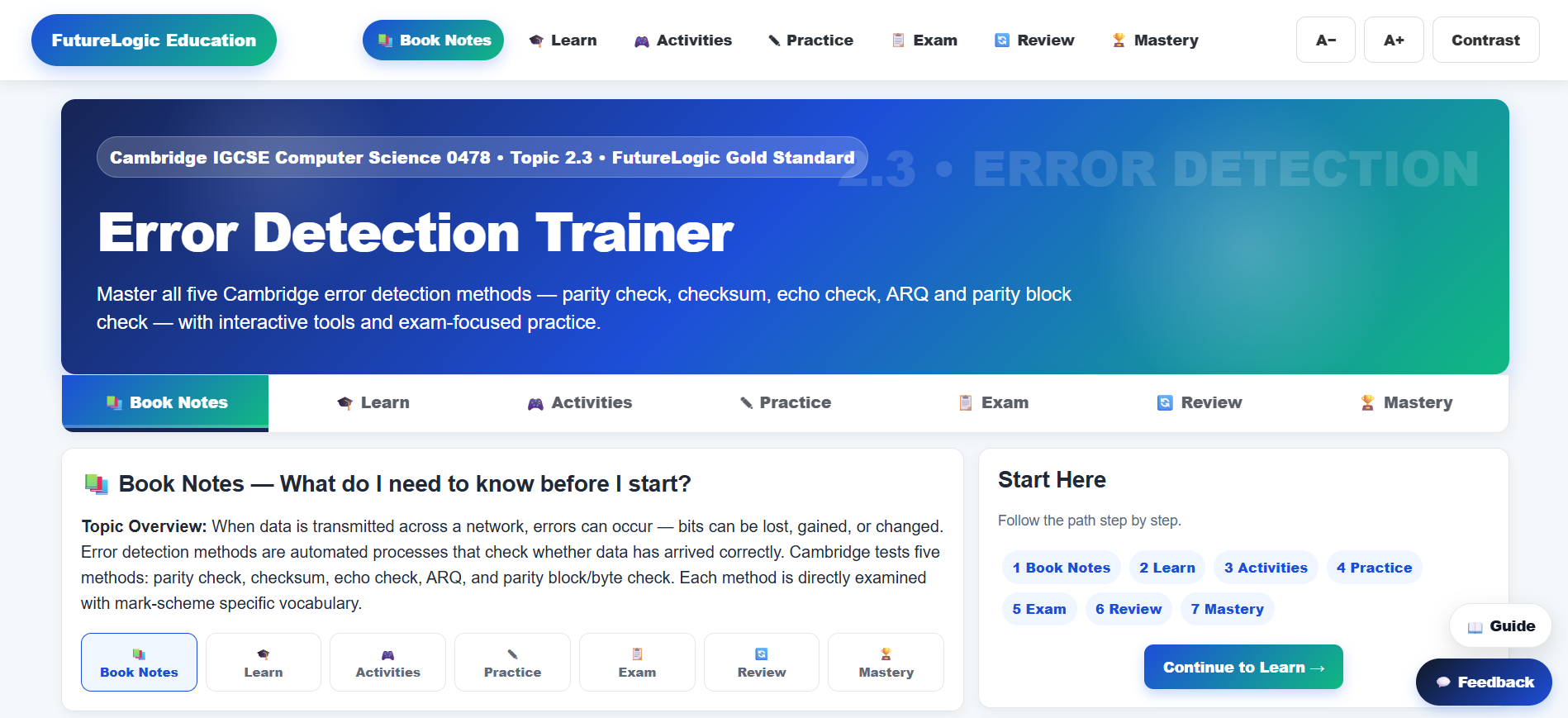
Master parity checks, checksums, echo checks, ARQ and parity blocks using guided learning and exam-focused practice.
Open in the Learning Hub →A topic hub links six trainers together, giving students one central place to continue learning and track progress.
Open in the Learning Hub →FutureLogic is designed to reduce confusion, build independence and prepare students for exam questions.
Students learn by doing, not just by reading or watching.
Examiner warnings, command words and mark-scheme focus are built into the learning journey.
Revision Notes, Learn, Activities, Practice, Exam, Review and Mastery create a repeatable path.
Students can see what they know, what needs work and what to revise next.
FutureLogic supports teachers with interactive trainers, revision resources and exam-style practice for Cambridge IGCSE Computer Science 0478 / 0984. Use the Learning Hub to reinforce difficult topics, or build focused question sets with the Exam Builder.
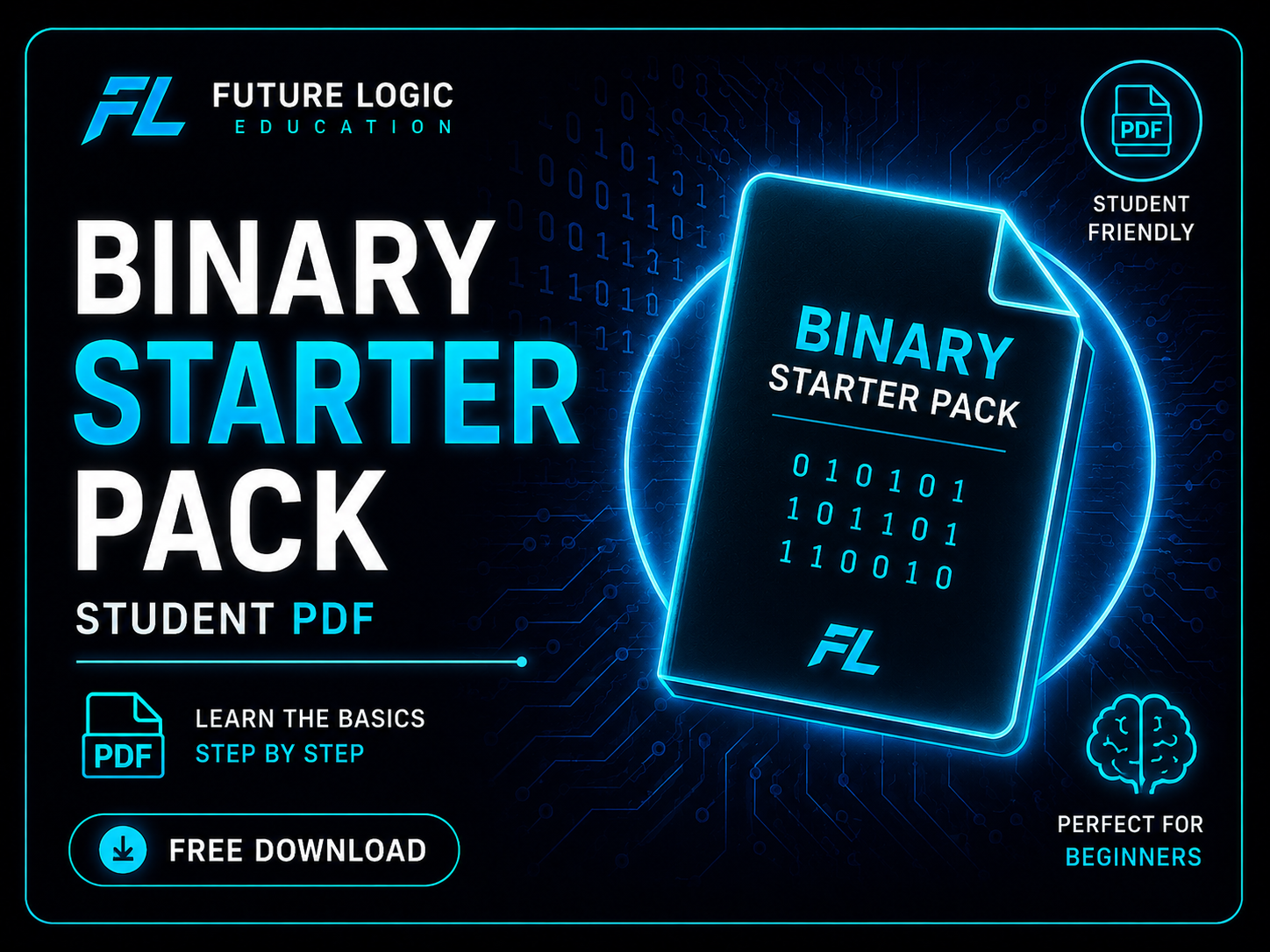
Get a beginner-friendly PDF covering binary basics, bits and bytes, conversion practice, ASCII, Unicode and exam-style questions.
FutureLogic brings Cambridge IGCSE Computer Science revision notes, interactive learning and exam-focused practice together in one structured platform.
Quick answers about the Cambridge IGCSE Computer Science course, the exams and how to revise.
The Cambridge IGCSE Computer Science 2026–2028 syllabus has 10 topics. Paper 1 covers Topics 1–6: data representation, data transmission, hardware, software, the internet and its uses, and automated and emerging technologies. Paper 2 covers Topics 7–10: algorithm design and problem-solving, programming, databases and Boolean logic.
Every topic has revision notes and interactive trainers on FutureLogic.
They cover the same course. The difference is the grading: 0478 is graded A* to G, and 0984 is graded 9 to 1. Your school chooses which one you are entered for, and you cannot take both in the same exam series. FutureLogic resources work for both.
There are two written papers, each worth 50%. Paper 1 (Computer Systems) and Paper 2 (Algorithms, Programming and Logic) are both 1 hour 45 minutes and 75 marks. Calculators are not allowed in either paper, and there is no coursework.
Paper 2 ends with a 15-mark programming scenario question. Practise it in our scenario section.
Most Paper 2 questions must be answered in pseudocode, so pseudocode is the key skill. For the 15-mark scenario question, you can use pseudocode or one of Python, Visual Basic or Java. Learning one language, such as Python, helps you test your ideas.
Start with our guide: What is pseudocode?
Work topic by topic. Read the revision notes, practise with an interactive trainer until you get questions right without help, then try exam-style questions and learn the exact vocabulary examiners reward. Spend extra time on pseudocode and trace tables, because they appear in most Paper 2 questions.
Read the full plan: How to revise IGCSE Computer Science.
Yes, many are. You can download free revision PDFs, watch free videos and claim the free Binary Starter Pack. Premium topic packs are available in the shop.
Explore the Learning Hub, try free resources, or start with the Binary Starter Pack.